
Activity Overview
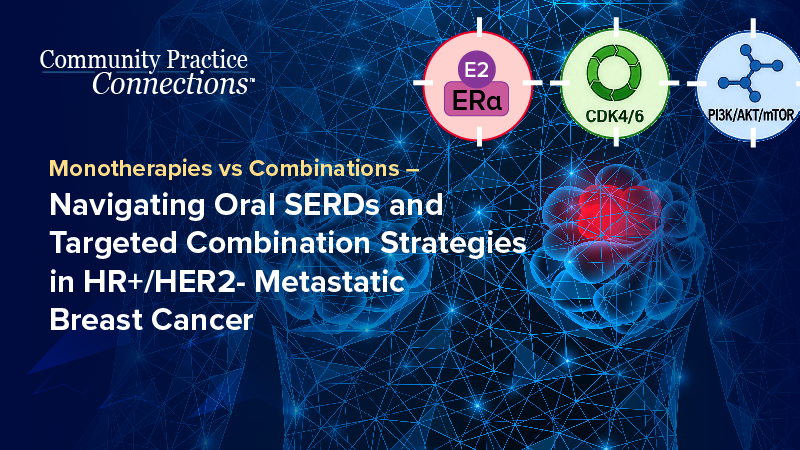
Hormone receptor–positive/HER2–negative (HR+/HER2–) metastatic breast cancer remains one of the most common and challenging diagnoses in oncology. While CDK4/6 inhibitor-based therapy has transformed first-line treatment, management of disease progression continues to evolve rapidly with the emergence of next-generation oral selective estrogen receptor degraders (SERDs) and targeted combination strategies.
This Community Oncology Connections program brings together academic and community oncologists in an interactive, case-based virtual series to explore the latest evidence on oral SERDs and targeted combinations in HR+/HER2− metastatic breast cancer. Designed specifically for the community-based clinician, the program translates recent clinical trial and real-world data into practical guidance for treatment sequencing, ESR1 mutation testing, and individualized patient decision-making.
Target Audience
This educational program is primarily directed toward a global audience of community-based medical oncologists, surgical oncologists, advanced practice providers, nurses, and other health care providers involved in the treatment of metastatic breast cancer.
Learning Objectives
Upon successful completion of this activity, you should be better prepared to:
- Apply real-world evidence for oral SERDs to individualize second-line treatment decisions in patients with ESR1-mutated, HR+/HER2− metastatic breast cancer following CDK4/6 inhibitor–based therapy
- Differentiate the efficacy profiles of approved oral SERDs (elacestrant, imlunestrant) and emerging combination regimens to guide treatment selection in HR+/HER2− metastatic breast cancer
- Evaluate the role of circulating tumor DNA-based ESR1 mutation surveillance in guiding preemptive endocrine therapy modification in patients with HR+/HER2− metastatic breast cancer
- Assess the adverse effect profiles of oral SERDs and targeted combination regimens used in HR+/HER2− metastatic breast cancer

Aditya Bardia, MD, MPH, FASCO
Professor of Medicine, Geffen School of Medicine
University of California, Los Angeles
Program Director, Breast Medical Oncology
Assistant Chief of Translational Research, Division of
Hematology-Oncology
Director of Translational Research Integration
UCLA Health Jonsson Comprehensive Cancer Center
Los Angeles, CA
Disclosures: Advisor, Consultant, Fee-for-Service Recipient: Alyssum, AstraZeneca/Daiichi Sankyo, Bristol Myers Squibb, Eli Lilly, Genentech, Gilead, Menarini, Merck, Novartis, Pfizer, Vyome; Grant/Research Funding: AstraZeneca/Daiichi Sankyo, Eli Lilly, Genentech, Gilead, Menarini, Merck, Novartis, OnKure, Pfizer

Kamel Abou Hussein, MD
Assistant Professor of Medicine
Cooper Medical School of Rowan
University
MD Anderson Cancer Center at Cooper
Camden, NJ
Disclosures: Advisor, Consultant, Fee-for-Service Recipient: AstraZeneca; Speakers Bureau: Lilly
The staff of Physicians’ Education Resource®, LLC have no relevant financial relationships with ineligible companies.
PER® mitigated all COI for faculty, staff, and planners prior to the start of this activity by using a multistep process.
Off-Label Disclosure and Additional Disclaimers
This activity may or may not discuss investigational, unapproved, or off-label use of drugs. Learners are advised to consult prescribing information for any products discussed. The information provided in this accredited activity is for continuing education purposes only and is not meant to substitute for the independent clinical judgment of a health care professional relative to diagnostic, treatment, or management options for a specific patient’s medical condition. The opinions expressed in the content are solely those of the individual faculty members and do not reflect those of PER® or any company that provided commercial support for this activity.
This accredited activity has been developed in accordance with applicable accreditation standards to ensure balance, independence, objectivity, and scientific rigor. Faculty were instructed to use generic names where possible and to base recommendations on the best available evidence.
In the context of clinical discussion, proprietary product names may be mentioned. Such references are made for educational purposes only and do not constitute endorsement of any commercial product or service.
Learners are encouraged to independently evaluate the information
presented and apply their own clinical judgment when considering patient care
decisions.
This activity may have used AI-assisted tools to support educational development. All content was reviewed and approved by qualified faculty or planners. The accredited provider retains full responsibility for accuracy, balance, and independence.
GET STARTED WITH THIS PROGRAM:
Register now to gain access to this program.
Create AccountAlready Registered? Login Here